
Intro to Genograms
A TOOL TO UNDERSTAND YOUR FAMILY SYSTEM
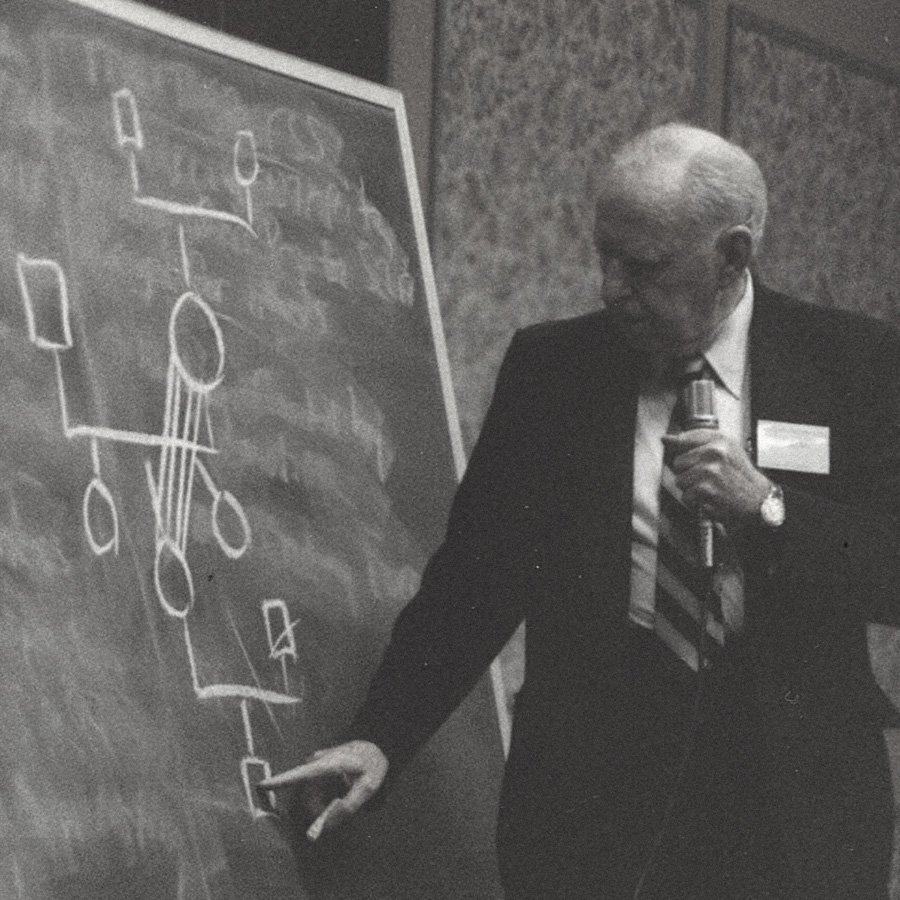
Dr. Murray Bowen in front of a chalkboard explaining a simple genogram.
What is a Genogram?
None of us exist in a vacuum. We are all born into a family that we didn’t choose. And because that family is the only context we know during the earliest (non-self-aware) years of life, it is inescapably formative. What we experience, observe, and are taught within our family system creates our foundational sense of self, our first understanding of the world, and our default strategies for getting our needs met. We can of course audit these things later in life and choose different paths. But in order to do so we need to bring the forces at work in our family system into the light, to better understand their impact on us. And that is precisely what a Genogram is meant to do.
Genograms build on Family Systems Theory and Murray Bowen’s concept of Multigenerational Transmission Process. This is essentially the idea that one can observe patterns and chain reactions within the generations of any family system that help explain the behaviors and pathologies of the individuals in the system. Put simply, stuff gets passed down.
A Genogram is essentially a family tree, presented in a visual format, overlayed with information like the presence of abuse, addictions, or depression, as well as things like cultural or religious influences. Mapping this information onto a graphic (with standardized symbols) helps us see patterns and connect dots that may we may have otherwise overlooked.
The process of populating a Genogram with this information is powerful in and of itself because it requires a certain kind of attention. It requires us to “zoom out” (i.e. out of our own heads) to see ourselves in a wider cultural and generational context. And it demands we consider the story or each individual, seeing them as complex human beings navigating the complexities of life, just like us. As a result, Genograms often have the effect of increasing empathy or, at the very least, understanding for others in the family system.
Gathering information for a Genogram can also offer an excuse to ask questions of family members, particularly older generations. For example, you ask your mom, “What do you remember about grandma and grandpa’s marriage?” The answers are often revelatory, in both positive and negative ways. You may hear stories of virtue, you may hear family secrets exposed. This can be unsettling, but also empowering, as it frees us to live in the truth and reshape own narratives.
A CASE STUDY
Consider Kyle, a 25 year old male who comes into therapy struggling with depression and worried about his increased alcohol consumption. Kyle describes his childhood as “normal” and wonders why he’s depressed when he has a good job and longtime girlfriend. Kyle has never had a close relationship with his dad, but in order to populate his Genogram he contacts him to ask about Grandpa Pete. As a kid Kyle experienced his grandpa as warm, but Grandpa Pete died when Kyle was 8 and he’d never given much thought to his story. Suprisingly, Kyle’s dad opens up and tells him Grandpa Pete was “probably an alcoholic” in the early years, which led to a tense and sometimes violent home. Kyle’s dad goes on to talk about Great-Grandpa George, a WWII veteran who lost his brother in the war and his wife to divorce. He describes George’s alcoholism and death by suicide at age 59. Mapping this onto his Genogram, Kyle begins to consider his own dad in this context, remembering how he’d find him asleep in his easy chair with a whiskey glass every night.
Making your Genogram
There is loose standardization (for lack of a better term) in Genogram formatting. A basic set of symbols and strategies was established in the 1980’s by a committee that included Dr. Murray Bowen himself. But like any widely-used framework, it has seen critiques and additions from various groups over the years, which creates some variation in clinical usage. It’s best to use whatever guide you find most helpful, but figure out the system that works best for you. A thorough Genogram contains a lot of information and, as a result, can often start to look messy. That’s okay. The considered attention you give to populating the Genogram is what’s important, not the prettiness of the final graphic.
The link below contains a basic how-to, complete with a key of the standard Genogram symbols. You’ll find a three part evolution of Kyle’s (above) Genogram. See what observations you can make about the forces that shaped Kyle’s life and contributed to his current issues.