Window of Tolerance
Note: this framework shares language with Dr. Stephen Porges’s Polyvagal Theory, which has recently been the center of debate in the world of psychology. Polyvagal Theory attempts to understand human reactivity through the lens of the autonomic nervous system (ANS). It posits that our bodies prioritize safety through social engagement (ventral vagus), mobilization (sympathetic fight-or-flight), or shutdown (dorsal vagus) based on a subconscious, pre-conscious evaluation of safety known as neuroception. A recent article by Paul Grossman questioned some of the science of Polyvagal Theory and Porges himself responded. I bring this up so that we can engage tools like the Window of Tolerance as helpful theoretical constructs rather than airtight biological science. In my perspective, any tool that help us put language to our experience is useful.
An Overview
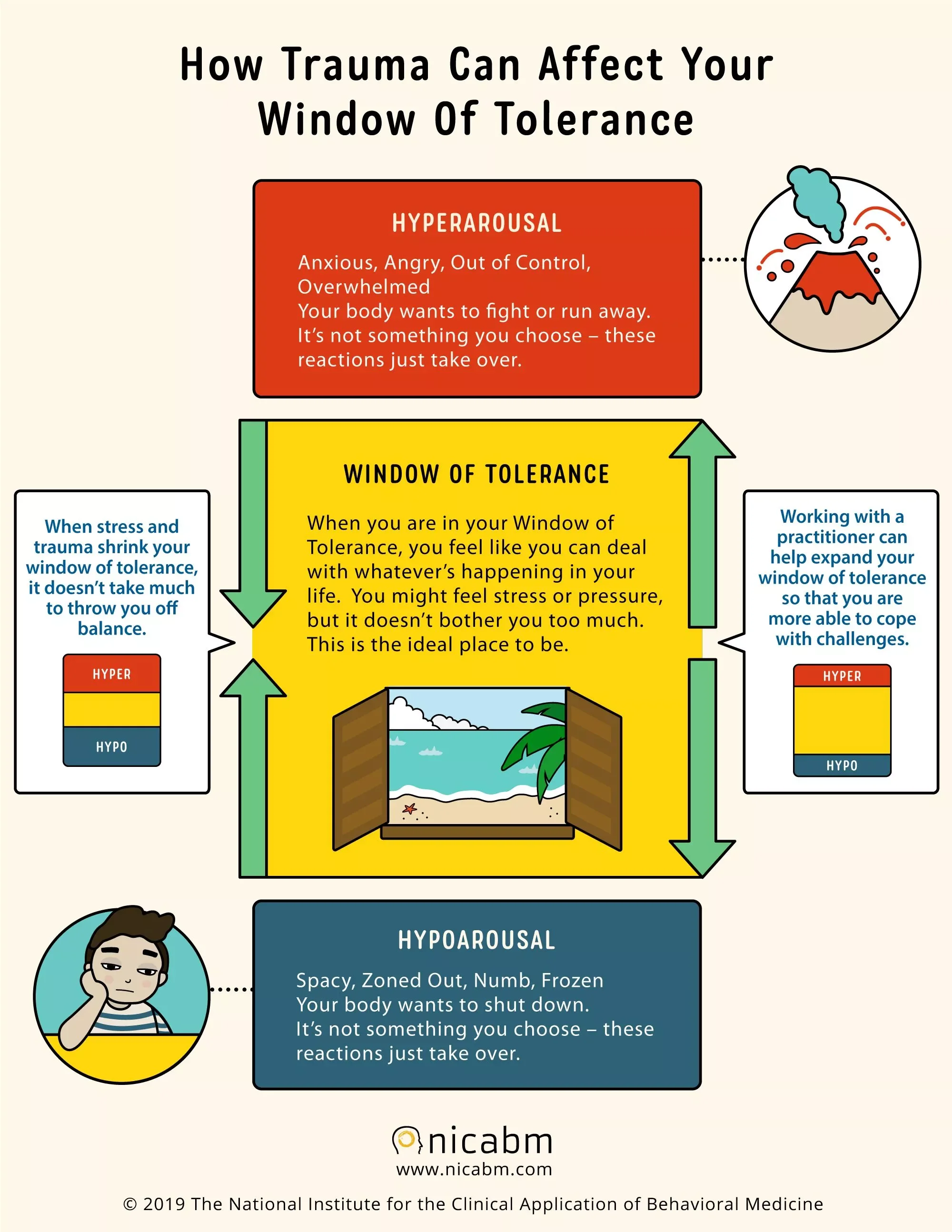
The Window of Tolerance is a framework developed by Dr. Dan Siegel, MD to conceptualize states of reactivity. In this framework there are three zones a person can exist in. The “window of tolerance” is visualized in the middle and represents the optimal zone for “arousal”, meaning in this state a person is not triggered. A person is pushed out of their window when stimuli is interpreted as a threat, or becomes overwhelming. They either get pushed up, into hyper-arousal, or down, into hypo-arousal. Hyper-arousal (up) is an activated fight or flight state. Here your internal system is ramping up to meet the threat. Hypo-arousal (down) is a shut-down, dissociative state. Here your internal system is powering down to avoid pain.
How This is Helpful
It gives us shorthand language to describe our internal state. Whether we’re working with kids or talking to our partners “I’m out of my window” is a great, simple way to communicate dysregulation. And once a person has tools for self-regulation, they can conceptualize what will help them “get back in their window”.
It demarcates the emotional (and behavioral zone) we want to live in, and helps us become more aware of when we’re leaving that zone. In therapy we often reference the experience of moving into dysregulation as “hitting the rumble strips”. If we can get an experiential sense of what it feels like to be moving toward dysregulation, we can catch ourselves before we’ve get totally “pushed out of our window”.
It helps us conceptualize resilience as a “shrinking” and “widening” zone. If difficult life events, poor sleep, etc. shrink my window of tolerance it will not take much to push me into dysregulation. In contrast, if I’m doing the work of therapy, finding a good work/life balance, eating and sleeping well, I’ll likely expand my window, making it harder for something (or someone) to push me out.
It gives me a sense of what will help “correct” the state I’m in. For example, if I’m up in hyper-arousal, I need to come back down into my window. So things that calm my system will be most helpful. I’m I’m down in hypo-arousal, things that activate my system will be most helpful.
Recognizing the States
How do you know if you’re in your window of tolerance? It typically feels calm (non-activated), but that doesn’t mean everything around you is great and you aren’t being affected. You’ll just feel like you can handle things. Your rational thinking will still be online. You’ll be able to remain connected to others, empathizing with them and seeing their perspective. You’ll be able to be flexible and creative, open to possibilities. You’ll be able to laugh and have gratitude.
How do you know if you’re in hyper-arousal? You’ll notice your temper shortening or rising. You’ll get defensive or aggressive easier. You might feel a rush of adrenaline, quickened breath, tightening muscles, or even shakiness. You experience an anxious freeze, where you’re overwhelmed and paralyzed, but churning inside. You might slip into hyper-vigilence, controlling behavior, or recklessness.
How do you know if you’re in hypo-arousal? You start to think “what’s the point?” This state feels like depression and numbness. You might notice low energy or a loss of motivation. You might doom scroll, stay in bed, or just sit and state. Your thinking might get foggy and your voice might get low/soft. A negative script might be playing in your mind or you might distract yourself with fantasies or substances.