Emotional Vocabulary
Why Emotional Vocabulary is Helpful
Emotional vocabulary is the ability to name and communicate one’s internal state. If you ask someone with a low emotional vocabulary how they’re feeling, they might only know how to say they’re “frustrated”. And when you ask for more information they might say, “I don’t know I’m just frustrated.” (There’s likely other things happening in this situation as well, like the person not feeling safe opening up, blocking their willingness to even explore. But that’s another discussion).
In contrast, someone with a wider emotional vocabulary might be able to communicate, “I guess I’m feeling sad and I’m realizing how much I was banking on that particular outcome. Feels like a loss and I’ve experienced a lot of disappointment lately. It all just makes me feel powerless.”
Looking at the two, which person is better equipped to respond to their own emotions in a constructive way? And which person is more likely to end up feeling known, validated, and cared for by others? Consider this metaphor:
You’re renovating your office and your wife asks if she can help. You actually are feeling a bit alone in the project, so you readily accept her offer and ask her to get the paint for the room.
“Great. What color are you thinking?” she asks.
“Blue,” you say.
Assuming she’ll get more info later, she heads to the store. Then, standing in front of the color samples, she calls. “Hey. So what color are you thinking?”
“I said blue.”
“Yeah I heard, but there are a lot of blues. Are you thinking navy? Robin egg? Royal blue? I really want to make sure I get what you’re looking for.”
“I said blue! Why can you never just accept my answer? You’re always trying to pry! But I already told you!”
In this metaphor the wife is actually wanting to understand and help. But it’s the lack of vocabulary (along with lack of regulation) that prevents the connection from happening. Likely, the wife’s response will end of being “wrong” in the eyes of the husband, who might then reinforce the narrative that no one understands him.
The ability to be specific and/or descriptive makes all the difference. How is anyone supposed to know where to find you, where to join you, if you struggle to describe where you are?
Increasing Vocabulary
One of the ways you can increase your emotional vocabulary is through reading and engagement of the arts. Poetry, in particular, sharpens our ability to link sensations, abstract thought, and illustrative terms. Likewise, a well-written screenplay or resonant line in a song can help put words to our inner experiences we would have struggled to find on our own.
Journaling can also be helpful, particularly because it allows you to “practice” noticing your internal state and putting words to it, without feeling pressure to “get it right” in conversation. You can obviously just start journaling; you don’t need a program for it. But you can also find more structured regimens, like morning pages in The Artist’s Way. The key to the practice of morning pages is the discipline. You’re asked to write three pages (it can be shorter) by hand every morning, whether you feel like you have something to say or not. By forcing yourself to pay attention and put language to your inner world in this way, you begin to free up resistance or perfectionism and expression becomes more natural.
Another helpful tool is a feelings wheel (pictured below), which is like a pie chart divided into core emotions, with increasingly specific language as it moves outward from the center. There are various iterations of a feelings wheel, with people putting different core emotions in the center and adding their own corresponding terms. To use a feelings wheel, simply pick the basic emotion in the center ring that most corresponds to what you’re feeling. Then move outward, paying attention to the nuance and intensity of what you’re feeling. Feelings wheels work great with kids. But there’s no shame in referencing one as an adult.
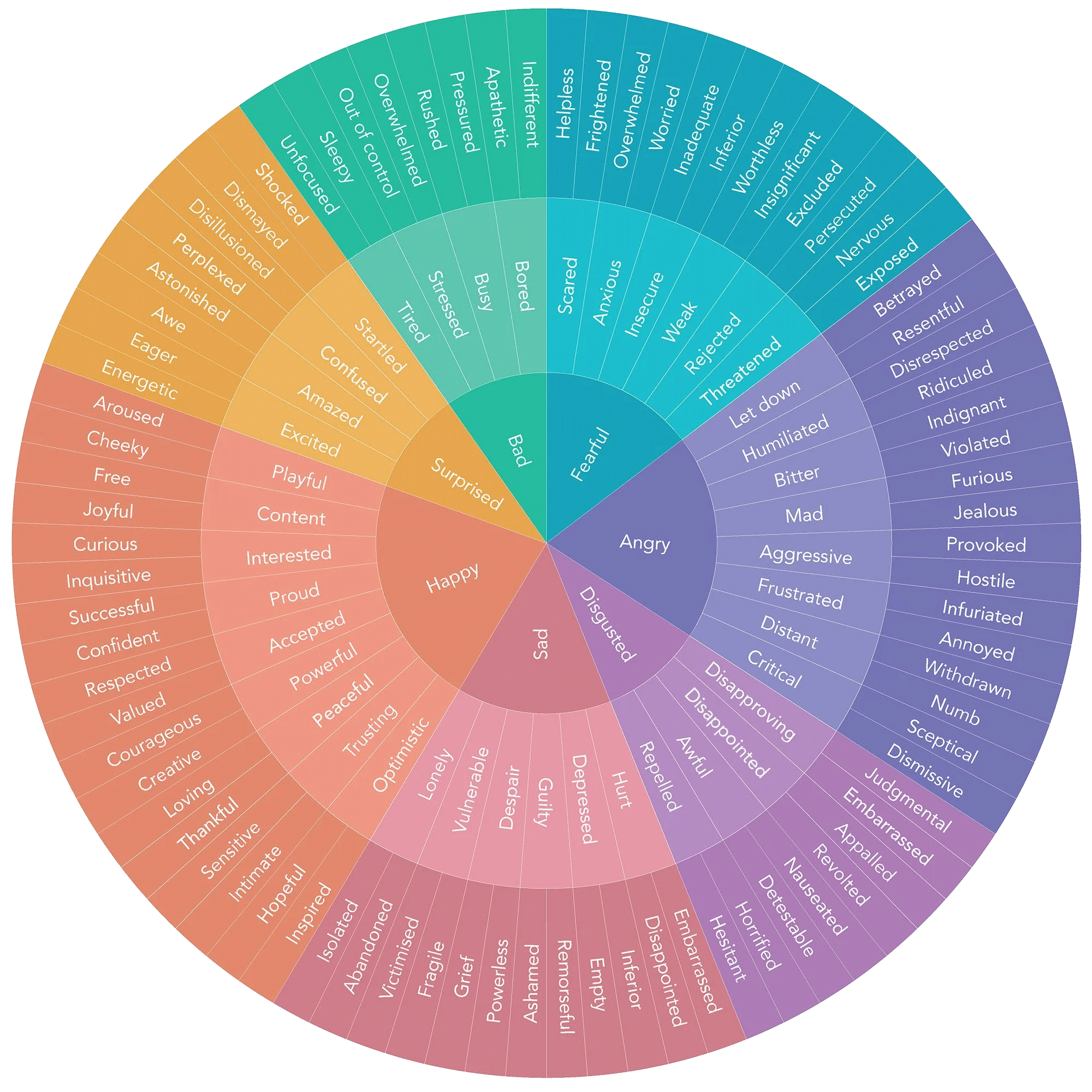
Variations on the Feelings Wheel
In the previous post we discussed how emotions are really about the dynamic between our mind’s interpretation of events and how we experience the subsequent response in our bodies. To help bring insight to that experience, a therapist named Lindsay Braman created her own version of a feelings wheel that populates the outer ring with bodily sensations. Her emotion-sensations wheel (linked at the top), names things like “queasy” or “furrowed brow” and helps you reverse engineer the emotion connected to the physiology.
Another variation comes from American psychologist Robert Plutchik, who created Plutchik’s Wheel of Emotion (linked at the top) in 1980. What’s different about Plutchik’s approach is that he names eight core emotions, then explores the relationships between them. He sets them up in pairs of opposites (e.g., sadness and joy), but also labels the space between emotions where they overlap (e.g., surprise + fear = awe). Plutchik’s approach has a bit more dimension to it. But, like other theories within psychology, his particular construct remains open to debate.